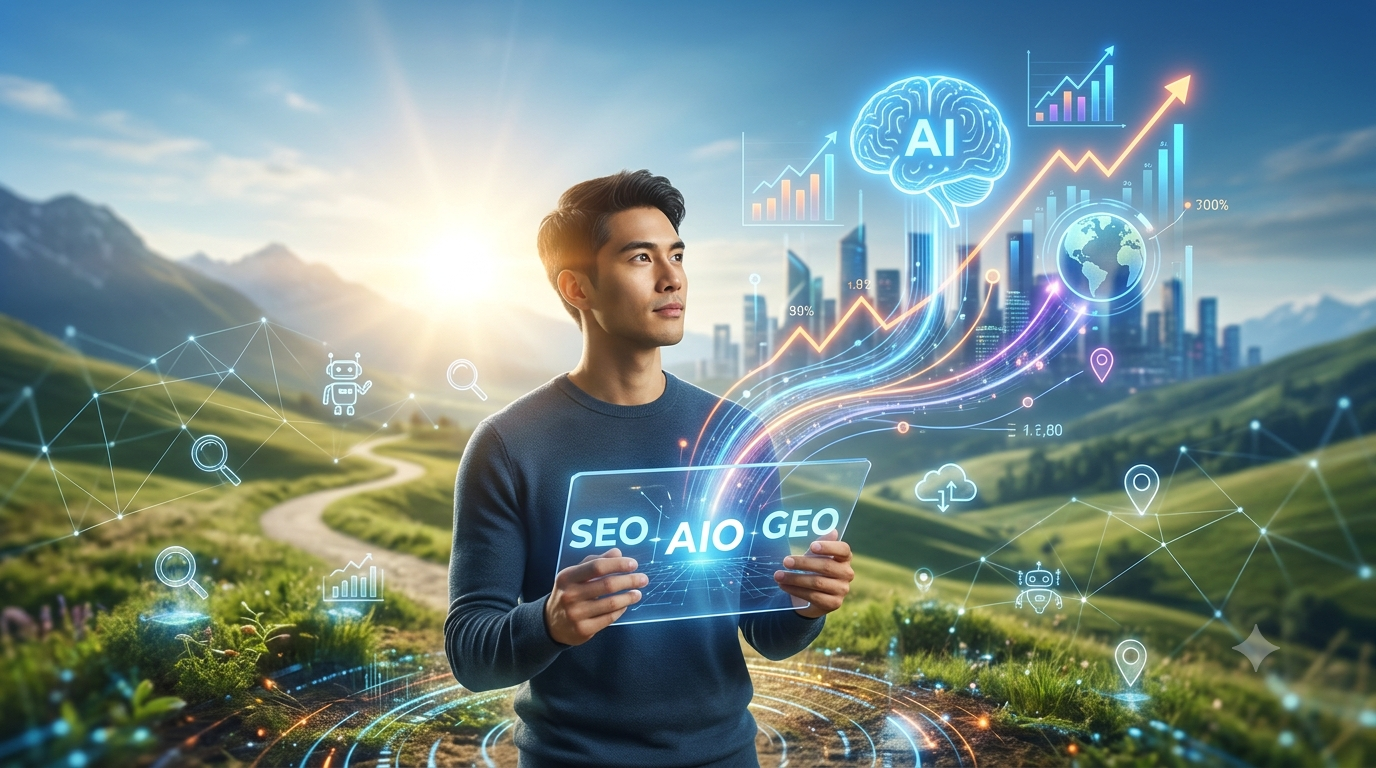
The digital marketing landscape is undergoing a massive seismic shift. Just a few years ago, the ultimate goal for any business was simple: conquer “SEO” to reach the top of Google’s ten blue links. But the game has changed entirely. With the explosive rise of Artificial Intelligence (AI), the way users hunt for information has fundamentally transformed.People are no longer just typing fragmented keywords into a search bar and scrolling through pages of results. Instead, they are having dynamic conversations with AI chatbots and receiving highly accurate, synthesized answers directly on the search engine results page (SERP).To survive and thrive in this new era, relying on traditional Search Engine Optimization is simply not enough. Enter two vital new concepts: AIO (AI Optimization) and GEO (Generative Engine Optimization). In this comprehensive guide, we will break down what these three pillars mean, how they differ, and what you need to do to future-proof your content strategy.1. What is SEO (Search Engine Optimization)?Traditional SEO is the foundational practice of optimizing a website to rank organically on search engines like Google, Bing, or Yahoo.The Primary Goal: To achieve high rankings for specific keywords, drive organic traffic, and increase overall website visibility.How It Works: SEO relies heavily on keyword research, on-page optimization (title tags, meta descriptions, headings), technical site health (page speed, mobile-friendliness), and building a robust backlink profile.The Current Reality: Let’s be clear—SEO is not dead. It remains the bedrock of digital marketing. However, the rules have evolved. Search engines have become highly sophisticated, prioritizing user intent, semantic relevance, and content quality over sheer keyword density.2. What is AIO (Artificial Intelligence Optimization)?AI Optimization (AIO) is the strategic process of ensuring your brand, content, and products are discoverable and accurately represented by Large Language Models (LLMs) and AI chatbots like ChatGPT, Claude, and Gemini.Think about how people use the internet today. A user might prompt an AI with, “What are the top 5 CRM software tools for small businesses, and what are their pros and cons?” The AI doesn’t give them a list of links; it gives them a direct, comprehensive answer. If your brand is not part of the data these models ingest and trust, you simply won’t exist in their responses.The Primary Goal: To establish your brand or content as a trusted entity and primary source of truth within AI platforms.How It Works: AIO requires focusing on Natural Language Processing (NLP). It involves writing in a highly conversational, entity-rich manner and ensuring your brand is mentioned positively across high-authority platforms that AI models use for training data.3. What is GEO (Generative Engine Optimization)?GEO, or Generative Engine Optimization, targets the new hybrid search experiences—specifically AI-driven search engines like Google’s AI Overviews, Bing Copilot, and Perplexity AI.When a user asks a complex question, a generative engine synthesizes information from multiple live web sources to create a unified summary, typically placing this AI-generated answer at the very top of the SERP. Crucially, these engines provide citations or source links to the websites they pulled the information from. GEO is the art of getting your website chosen as one of those cited sources.The Primary Goal: To secure citations, references, and visibility within AI-generated search summaries.How It Works: GEO heavily rewards authoritative data. Content optimized for generative engines must include original statistics, expert quotes, clear definitions, and flawless technical structure (like Schema Markup) so the AI can instantly extract and verify the facts.The Core Differences: SEO vs. AIO vs. GEOTo make things crystal clear, here is a breakdown of how these three strategies compare:FeatureSEO (Search Engine Optimization)AIO (AI Optimization)GEO (Generative Engine Optimization)Primary TargetTraditional search engine algorithmsAI Chatbots and LLMs (ChatGPT, Gemini)AI-powered search interfaces (AI Overviews, Perplexity)Desired OutputBlue links on a SERPDirect brand mentions and recommendationsCitations and source links within AI summariesKey TacticsKeywords, backlinks, site speedNLP, brand authority, conversational toneOriginal statistics, expert quotes, structured dataUser InteractionUser clicks a link to find the answerUser gets a conversational answer directlyUser reads a generated summary and clicks citations for depthHow to Future-Proof Your Content StrategyYou cannot afford to operate in silos anymore. A successful digital marketing campaign today requires a blended approach that incorporates SEO, AIO, and GEO. Here is how you can adapt your content to win across all fronts:1. Write for Humans, Structure for MachinesRobotic, keyword-stuffed content is entirely obsolete. Write naturally, using a conversational tone that directly answers the user’s questions. Use transitional words and semantic variations. This human touch appeals to readers, while clear formatting (bullet points, H2/H3 tags) helps AI bots parse your information effortlessly.2. Double Down on E-E-A-T (Experience, Expertise, Authoritativeness, Trustworthiness)AI engines are terrified of “hallucinating” (providing false information). Therefore, they heavily favor sources with proven authority. Include original research, case studies, statistics, and quotes from subject matter experts. The more verifiable and trustworthy your data is, the more likely generative engines will cite you as a source.3. Master Structured Data (Schema Markup)If you want AI to understand exactly what your content is about, you need to speak its language. Implementing robust Schema Markup (like FAQ schema, How-To schema, or Article schema) translates your content into machine-readable data. This makes it incredibly easy for generative engines to pull your specific insights into their summaries.4. Build a Multi-Channel FootprintAI models don’t just scrape traditional websites; they pull massive amounts of context from platforms like Reddit, Quora, LinkedIn, and YouTube. To dominate AIO, you need an active presence across multiple channels. Encourage positive brand discussions on forums and social media, as this broader digital footprint heavily influences how AI perceives and recommends your brand.The Bottom LineWe are stepping into a golden era of search, one where precision, authority, and context rule above all else. Traditional SEO isn’t stepping aside; it is simply making room at the table for AIO and GEO. By shifting your focus from “ranking for keywords” to “providing the most authoritative, machine-readable answers,” you will not only survive the AI revolution—you will lead it.